



Table of Contents
- Retail Layoffs
- Tech Layoffs
- What Factors Are Companies Citing?
- Structural vs. Cyclical Factors
- Recent Layoff Announcements by Technology Firms: Selected AI-Focused Commentary and Reports
Reasons to Read
Discover how AI is reshaping global retail and tech employment—and what it means for the future workforce.
Read this report to discover answers to these and other questions:
- Are current retail and tech layoffs being driven more by structural changes like AI adoption—or by cyclical economic pressures?
- How do 2025 layoff trends compare to 2024 across both tech and retail industries?
- What specific factors are companies citing when announcing layoffs, and how does AI play a role?
- What distinguishes structural from cyclical workforce shifts—and why does it matter for long-term business strategy?
- Which companies are leading (or lagging) in adapting to AI-driven transformation, and how will this impact competitive advantage?
Companies mentioned in this report include: Accenture, Adobe, Alphabet/Google, Amazon, Autodesk, IBM, Microsoft, Nestlé, Salesforce, SAP, Scale AI and Tata Consultancy Services.
Data in this report include: Global retail and tech layoff totals and announcement counts; company-level layoff announcement; AI-related restructuring commentary; analysis of layoff timing by month.
Executive Summary
The ongoing layoffs in the tech and retail sectors are increasingly driven by structural changes, influenced by the adoption of AI and generative AI, rather than cyclical economic factors. AI and automation are reshaping workforce needs by replacing traditional roles and creating new skill demands. To offset the substantial investments in these technologies, companies are implementing layoffs to reduce operational costs. While economic conditions still influence workforce reductions, the long-term impact is due to technological disruption.
Coresight Research Analysis
- Year to date, the retail sector has seen 45,841 positions eliminated in 56 announcements, compared to 49,175 layoffs in 87 announcements during the same period of 2024. The data are global and through October.
- The tech sector has experienced 131,445 layoffs in 173 announcements year to date, compared to 123,001 layoffs in 382 announcements in the same period of 2024.
- The primary drivers of layoffs in both sectors are increasingly structural, with AI and automation in technology and e-commerce and AI in retail reshaping workforce demands, rather than shorter-term economic cycles.
- While cyclical factors such as inflation and tariff announcements and implementations have intensified layoffs, they act more as accelerants to underlying structural changes, with companies using downturns to restructure and accelerate technology adoption.
What We Think
While layoff announcements in 2025 may not reach previous peaks, workforce reductions in the tech and retail sectors remain a critical issue, increasingly driven by structural changes rather than cyclical economic factors. Technological advancements, including AI, automation and data analytics, are replacing low-skill jobs and creating new roles that require specialized expertise.
These structural shifts are expected to continue reshaping the workforce in both sectors. Companies must adapt by focusing on reskilling and upskilling to meet the demands of a more digital and automated labor market. As automation and AI transform operational models, organizations are not just reacting to short-term economic pressures but reimagining their business models for the future. This requires a strategic focus on workforce adaptation through training and reskilling to align with evolving industry needs.
Introduction
We examine layoffs across the global retail and technology industries. In this analysis, we explore whether workforce reductions are primarily driven by cyclical factors—such as a slowdown in the economic cycle—or by structural shifts—resulting from the ongoing adoption of artificial intelligence (AI), including the disruptive influence of generative AI (GenAI). By identifying the underlying drivers of these workforce changes, we aim to better understand the long-term implications for labor markets in both sectors.
The data in this report are global, with a natural weighting toward US tech firms (including giants), and come from our Corporate and Financial Developments Databank, which our data team updates regularly through every working week.
Tracked Layoffs
Retail Layoffs
The retail sector has witnessed a substantial number of layoffs in 2025. A total of 45,841 employees were impacted (as of October 2025) across 56 announcements. During the same period in 2024, 87 announcements were tracked, and a total of 49,175 employees were affected.
March recorded the highest number of retail layoffs in 2025, with about 17,088 employees affected, driven largely by major announcements including the Hudson’s Bay Company’s layoff of 8,347 employees (89% of its workforce) ahead of its liquidation, Burberry’s plan to cut up to 1,700 jobs as part of a cost-saving initiative and Walmart’s planned reduction of roughly 1,500 corporate roles.
Figure 1.
Tracked Layoff Announcements by Retail Firms: Total Retail Layoffs (Left Axis; Thous.) and Number of Retail Layoff Announcements (Right Axis)
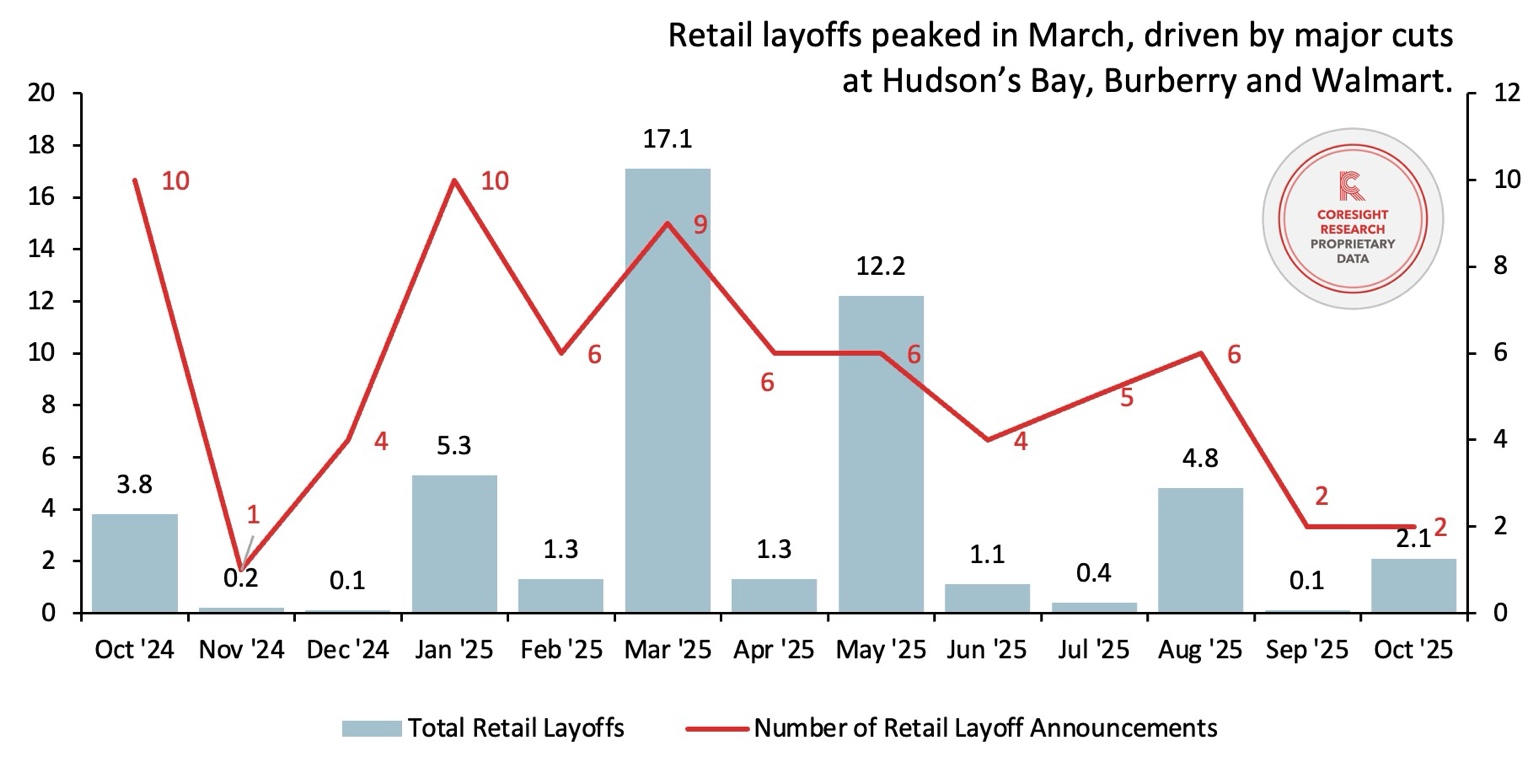
Data are global (although predominantly US) and are based on stated absolute layoff numbers where those are available. Where absolute numbers are not available, layoff numbers are zero, but the announcements are still counted.
Data are through October 31, 2025
Source: Coresight Research
Tech Layoffs
The technology sector has experienced notable layoffs in 2025, with approximately 131,445 employees affected year to date (as of October 2025) across 173 announcements. These figures mark a shift from the same period in 2024, when 123,001 employees were affected across 382 announcements.
A significant factor behind these trends has been the increasing adoption of AI and automation, along with huge investment in AI, which continues to replace manual roles such as software testers, help-desk/support staff, and routine monitoring functions—reshaping the overall workforce needs.
Layoffs intensified again towards the end of the year in 2025, with October recording the highest number of job cuts in the sector—around 33,200 employees—marking a peak in workforce reductions. This spike was largely driven by Amazon’s plan to lay off 30,000 corporate employees, marking its largest job reduction since late 2022, when it began cutting around 27,000 positions.
Figure 2.
Tracked Layoff Announcements by Technology Firms: Total Tech Layoffs (Left Axis; Thous.) and Number of Tech Layoff Announcements (Right Axis)
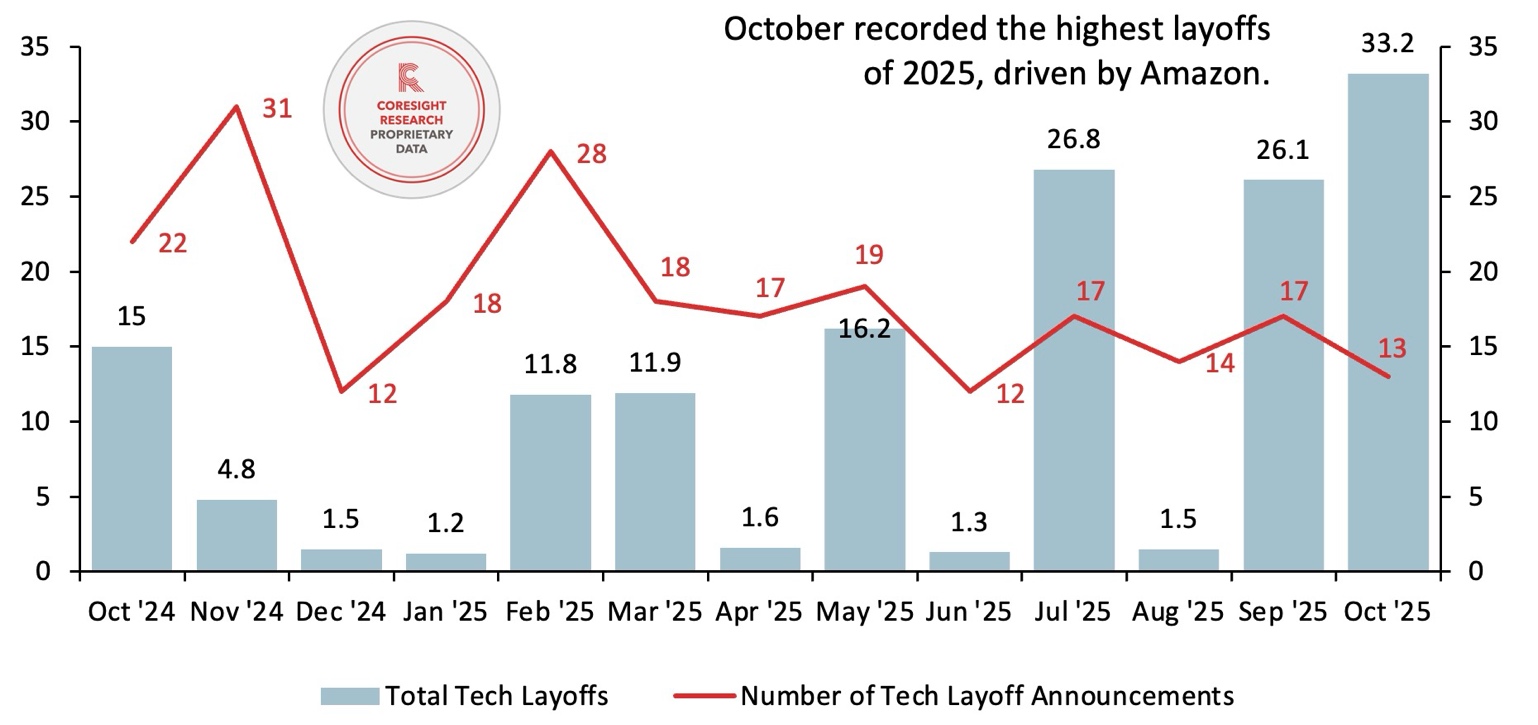
Data are global (although predominantly US) and are based on stated absolute layoff numbers where those are available. Where absolute numbers are not available, layoff numbers are zero, but the announcements are still counted.
Data are through October 31, 2025
Source: Coresight Research
What Factors Are Companies Citing?
In analyzing the causes behind layoffs, companies in both sectors have cited several common factors. These include:
- Economic Conditions: Both the retail and tech sectors have been impacted by global economic fluctuations. Economic uncertainty including related to tariffs and global trade tensions, inflationary pressures and changes in consumer behavior have led companies to downsize to maintain profitability.
- Restructuring: Many companies have cited the need to restructure their workforces as part of an effort to become more efficient or adjust to new business models. This is common in both sectors as businesses attempt to streamline operations and reduce costs.
- Technological Advancements: Another significant factor cited, especially in the technology sector, is the rapid pace of technological advancements, which can drive automation, shifts in business operations and increased investment in AI.
Structural vs. Cyclical Factors
At the core of these changes are two major forces: structural changes driven by technological advancements and cyclical factors driven by economic or business pressures. The distinction between structural and cyclical factors lies in their duration and impact on workforce strategies. Cyclical factors are typically short-lived, with layoffs often serving as temporary adjustments to economic or business conditions. When conditions improve, companies often rehire or shift their strategies to align with growth. In contrast, structural changes caused by technological advances or shifts in business models are long-term and often irreversible.
The retail sector, although more traditionally influenced by cyclical economic factors (such as shifts in consumer spending), is also undergoing a structural shift due to the rise of e-commerce and AI-driven technologies. As some physical stores close and online platforms expand, traditional retail roles (e.g., in-store salespeople, cashiers) are being replaced by more digital, data-driven roles (e.g., digital marketers, data analysts). While layoffs in retail have primarily impacted lower-level, store-based roles such as salespeople and cashiers, AI is also automating higher-level, back-office functions, including marketing, HR, and customer service support. These technological advancements are reducing the need for manual labor in both customer facing and administrative roles. This evolution, driven by technology, represents a structural change that will continue to reshape the workforce in retail, pushing businesses to focus on tech-savvy employees capable of managing online sales and digital logistics.
The rapid adoption of AI and automation in the tech industry is driving a fundamental transformation of the workforce. Roles that were once manual—such as software testers, help-desk/support staff, and routine monitoring functions—are increasingly being replaced by technology, creating both challenges—such as job displacement—and opportunities—like the emergence of new types of jobs requiring specialized skills. While cyclical factors like inflation and slower growth have intensified layoffs, they act more as accelerants to underlying structural changes, with companies using downturns to restructure and accelerate technology adoption.
Recent Layoff Announcements by Technology Firms: Selected AI-Focused Commentary and Reports
1.Microsoft
- Layoff Details: In May 2025, Microsoft announced the layoff of approximately 6,000 employees, nearly 3% of its workforce. The reductions primarily affected management roles across various departments, including Xbox and LinkedIn.
- AI Integration: While the layoffs were not solely attributed to AI, Microsoft is heavily investing in AI, reportedly spending $80 billion on related infrastructure that fiscal year. The company is integrating AI into its products and services, which may have influenced the restructuring decisions.
2. Salesforce
- Layoff Details: In September 2025, Salesforce eliminated approximately 4,000 customer service roles following the deployment of AI-powered support agents. The company’s CEO stated that AI agents now handle half of all customer interactions, leading to a 17% reduction in support costs.
- AI Integration: The adoption of AI in customer service operations was a significant factor in the workforce reduction.
3. Autodesk
- Layoff Details: In early 2025, Autodesk announced a 9% reduction in its global workforce, affecting approximately 1,350 employees. The company cited the need to enhance efficiency and focus on growth areas like AI and platform development.
- AI Integration: The restructuring plan aimed to align Autodesk’s operations with its transition to a subscription-based model and increased emphasis on AI-driven solutions.
4. Scale AI
- Layoff Details: In 2025, Scale AI laid off 14% of its workforce, approximately 200 employees, along with 500 global contractors. The company attributed the layoffs to an overly rapid expansion of its generative AI division, leading to inefficiencies and unclear team missions.
- AI Integration: Despite the layoffs, Scale AI plans to reinvest and expand hiring in sectors like enterprise, public sector, and international markets later in 2025, focusing on more strategic AI initiatives.
5. Accenture
- Layoff Details: In 2025, Accenture announced the elimination of 11,000 positions globally. The company cited the inability to retrain staff for AI-related work as a primary reason for the layoffs.
- AI Integration: The decision reflects Accenture’s shift toward AI-driven services and the need for a workforce with specialized skills in AI and automation
6. Tata Consultancy Services (TCS)
- Layoff Details: In 2025, TCS announced 19,755 layoffs as part of a major restructuring effort.
- AI Integration: The company is integrating more AI and automation technologies into its operations, leading to workforce reductions, especially in roles that are being automated or streamlined.
What We Think
The Coresight Research View on GenAI
We stand at the cusp of a new revolution in AI with the advent of agentic AI
The first generation of AI, AI/ML (machine learning), centers on the ability of AI to find relationships—even hidden ones—among large amounts of data, and ML excels at prediction and optimization. The steady improvement in computing power, driven by Moore’s Law, and the resulting decrease in the cost of computing, aided by cloud computing, have served to enable greater capabilities of AI/ML. Today, AI/ML still offers productivity gains and optimization benefits for retailers and other enterprises.
The advent of GenAI, the second generation of AI, adds the ability to communicate in natural human language to handle unstructured data, such as text, audio and video. Early GenAI applications were the creation and summarization of text and chatbots with natural language interfaces. Multimodal models enable the analysis and creation of voice and video, as well as synthetic data and computer code. We have also seen the creation of applications that manage multiple language models as well as the formation of businesses with new business models that are entirely built on GenAI technology. Combining AI/ML for making predictions with GenAI for its ability to generate multiple media outputs offers many powerful new capabilities.
Agentic AI builds upon GenAI’s ability to understand natural human language, which is used to create the instructions that agents follow. Agents take action, activating other software, following instruction or acting proactively on behalf of humans. We are in the early stages of the agentic AI revolution, with major cloud computing platforms offering developer tools and a few enterprises just beginning to roll out agents. The future promises AI agents everywhere and their value could increase even further from agent-to-agent communication. Most recently, AI chatbot companies have launched APIs (application programming interfaces) for retailers to share their product details to make them findable by the language models, as well as agents for shoppers to complete purchases from within the chatbot.
Implications from This Report
While the volume of layoff announcements in 2025 may not match the historical peak of previous years, the workforce reduction trend remains a persistent and critical issue across the global technology and retail sector. These reductions are increasingly driven by structural changes, with technological advancements playing a central role, rather than traditional cyclical factors such as economic downturns.
The data analyzed in this report also reveal that these structural changes are likely to continue reshaping the workforce in both sectors for the foreseeable future. As AI, automation, and data analytics replace lower-skill jobs; new roles requiring advanced expertise are emerging. Companies are making enormous investments in AI and automation, and the layoffs are often part of efforts to reduce costs and offset these significant expenditures. This pervasive advancement of AI is fundamentally reshaping work environments in both technology and retail, with companies not merely responding to short-term economic fluctuations, but reimagining their business models for a future that integrates technology into all aspects of operations.
To remain competitive, companies must evolve their workforce strategies to focus on reskilling and upskilling initiatives, ensuring employees are equipped for new roles driven by these technological shifts. This ongoing technological restructuring highlights the need for businesses to adapt their workforce to an increasingly digital and automated labor market.
Companies Poised To Gain Advantage
- Adobe, Alphabet/Google, IBM, Microsoft, SAP and Salesforce have been among the early adopters in implementing GenAI in their platforms, creating a lead versus competitors.
- Customers of those companies’ platforms, including retailers and consumer goods firms, will be able to enjoy the benefits of GenAI, such as in productivity.
- GenAI is moving fast, and better tools will become available over time, so companies that are not locked into a single solution stand to benefit.
Companies That Risk Losing Advantage
- Companies without an AI strategy or that are not experimenting risk falling behind.
- Building AI models, where companies have specific needs that may not be fulfilled by generic models, may be expensive and challenging for smaller companies.
Notes and Methodology
Data and conclusions in this report are as of November 7, 2025.
Companies mentioned in this report include: Microsoft (NASDAQ: MSFT), Salesforce (NYSE: CRM), Autodesk (NASDAQ: ADSK), Scale AI, Accenture (NYSE: ACN), Tata Consultancy Services (NSE: TCS), Amazon (NASDAQ: AMZN), Nestlé (SWX: NESN), Adobe (NASDAQ: ADBE), Alphabet/Google (NASDAQ: GOOG), IBM (NYSE: IBM), SAP (XETRA: SAP).
This document was generated for